Prolepsia forecastYes / no
Will US property catastrophe reinsurance rates fall by more than 10% at the 1 January 2028 renewals, as reported by Guy Carpenter?
As of 16 November 2026, Prolepsia puts the chance of yes at 37%.
37%chance of yes
How Prolepsia reasons
The report Prolepsia wrote with this forecast.
How forecasts are made · Track record
TL;DR
Probability of Yes: 36.7%. Probability of No: 63.3%. Continued softening is supported by ample capital, but a decline strictly exceeding 10% in January 2028 versus January 2027 is less likely than not; a smaller decline also resolves No.
Key evidence
- The market is already cutting prices sharply. Guy Carpenter reported a preliminary January 2025 US index decline of 6.2%, followed by a preliminary 12% decline in January 2026.
- Capital and profitability support further competition. The September 2026 outlook projects approximately 6% growth in global dedicated reinsurance capital during 2026 and reinsurer returns above their cost of equity through 2028. These are projections, not observed US pricing outcomes.
- Ample capital does not mean unlimited price cuts. Gallagher Re reports that its reinsurance-group cohort returned approximately $15 billion to shareholders against $16 billion of first-half profits. Traditional capital excluding Berkshire Hathaway was broadly flat, tempering the message from headline capital growth.
- Soft markets can mature without reversing. At January 2016, Guy Carpenter reported regional index declines of 7–10%, with smaller reductions in the US than internationally, despite plentiful capacity. That historical analogue shows why continued softening does not establish a qualifying result.
Uncertainties
The January 2027 starting point is still unknown. Deep reductions then would leave less margin for another large cut, while retained profits and alternative capital could keep competition intense. Catastrophe losses during 2027, investment-market conditions and reinsurance demand could also change the balance.
The target is the aggregate US ROL Index, not a global index or risk-adjusted treaty quote. Its methodology incorporates exposure, risk-measurement and purchasing changes, so coverage changes can affect the outcome. An explicitly reported decline of exactly 10% resolves No.
Read the full report
TL;DR
Probability of Yes: 36.7%; Probability of No: 63.3%. Use No as the planning case: the January 2028 US index must fall strictly more than 10% from January 2027 to qualify. The decisive distinction is between continued price declines and another decline large enough to clear that threshold.
Context
As of November 16, 2026, US property catastrophe reinsurance is in a period of strong pricing competition. Guy Carpenter’s preliminary January assessments show a 6.2% decline in 2025 and a 12% decline in 2026. Capital supply and profitability support further reductions. The question is whether that pressure will still produce a qualifying cut after another renewal round and catastrophe season.
The target is January 2028 versus January 2027, not the cumulative decline from an earlier peak. The first qualifying official January assessment controls, subject to the specified error-correction rules. Exactly 10% is No. Guy Carpenter became Marsh Re on September 1, 2026; an explicitly identified successor index must still cover the same US market and renewal comparison.
Evidence
History supplies a useful restraint on extrapolation. An approximate reconstruction of the historical US index identifies eight declines exceeding 10% among 35 annual changes from 1991 through 2025, about 23%. Including provisional 2026 gives nine among 36, or 25%. These are descriptive readings of a mixed-vintage historical series, not a clean archive of first-published January assessments. Rounded observations, different renewal coverage and clustered soft-market years limit their value as precise base rates.
The longer historical chart identifies qualifying declines in 1995, 1997–1999, 2004, 2008, 2010 and 2014. Those chart-derived observations show that large reductions recur, but not in every soft-market year. Current conditions justify taking sustained competition seriously without treating successive double-digit cuts as automatic.
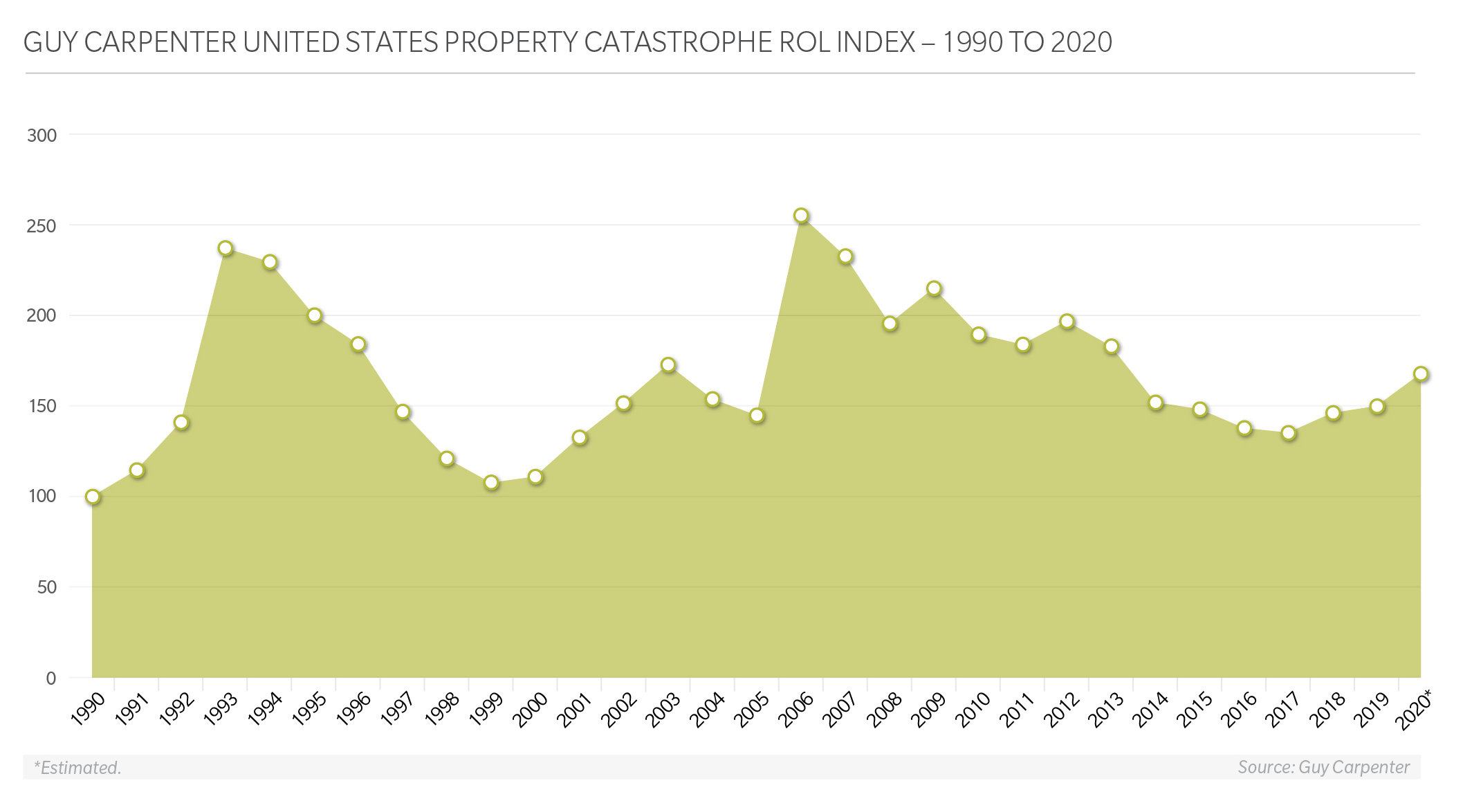
A better-documented analogue explains the mechanism. Guy Carpenter reported a 15% US decline at January 2014. At January 2016, it reported regional index reductions of 7–10%, with smaller reductions in the US than internationally. Plentiful capacity remained, but earlier cuts and increased demand moderated further reductions. A catastrophe-driven reversal is not necessary for No.
Recent pricing evidence points more strongly toward competition. The reported sequence is a preliminary 6.2% decline at January 2025, a 6.7% decline after midyear 2025, a preliminary 12% decline at January 2026, and a 16% decline across the 2026 renewals through June/July. The January and midyear figures cover different renewal bases. They must not be compounded as sequential cuts. They do show that downward pressure persisted beyond January.
Capital supply is the strongest reason that pressure can last. The September outlook projects global dedicated reinsurance capital rising from $663 billion in 2025 to $705 billion in 2026, approximately 6%, while the first-half reinsurance premium base contracted approximately 7%. Its profitability estimates, dated August 16, 2026, project returns on equity of 16.7% in 2026, 15.5% in 2027 and 15.1% in 2028, still above the estimated cost of equity (outlook). These are global projections. They support room for competition, not a direct prediction of the target US index.
Other capital estimates tell a similar broad story but use different definitions. Aon estimates global reinsurance capital of $800 billion at June 30, 2026, including $144.5 billion of third-party capital. Its sample of 19 global reinsurers recorded a first-half P&C reinsurance combined ratio of 85.4%, compared with 94.8% in the corresponding 2025 period. Those figures indicate strong underwriting results; they are not US catastrophe-only margins.
The counterweight is capital discipline. Gallagher Re estimates dedicated capital rose from a restated $654 billion at December 2025 to $688 billion at June 2026. Alternative capital reached $147 billion, but traditional capital excluding Berkshire Hathaway was broadly flat. Its reinsurance-group cohort generated approximately $16 billion of first-half profits and returned approximately $15 billion to shareholders (half-year report). The inference is narrower than “capacity is scarce”: profits do not all become fresh underwriting capacity.
Near-term market views are also mixed. A November interview anticipated approximately 15% reductions at January 2027. Other reporting quoted RenaissanceRe expecting further cuts but less pressure than in 2026, while Everest described greater selectivity as returns compress (industry commentary). These are informed commercial views about nearer renewals and company portfolios. They do not measure January 2028.
Capital-market pricing offers a weak moderation signal. Catastrophe-bond spread-to-expected-loss multiples moved from 2.29 in the second quarter to 2.27 in the third quarter of 2026, while spread above expected loss increased from 3.74% to 3.97%. Full pricing data covered only 10 of 15 third-quarter tranches, totaling $820 million (Artemis report). This is evidence of stabilization in an adjacent market, not proof that treaty pricing has turned.
What's non-obvious
No does not require rates to rise. The obvious narrative is that abundant capital produces lower prices. That narrative can remain correct while this question resolves No. A large January 2027 reduction would reset the base downward before the target year begins. Continued competition in 2028 could then produce a smaller cut as reinsurers protect returns. This is why evidence about current softness carries less weight than it first appears to.
Competition can also change coverage rather than just price. Aon describes interest in lower layers, frequency protection and multiyear capacity. Guy Carpenter’s index definition incorporates exposure, risk-measurement and purchasing changes. The inference is that buyers can gain value without an equivalent fall in measured ROL. The direction and size of that effect remain uncertain.
Uncertainties
The largest unknown is the January 2027 starting point. Its actual index change, coverage terms and underlying margins will show how much of today’s competitive pressure has already been absorbed. The next key evidence is deployable capital relative to US demand, rather than global capital totals alone. Capital returns, retained profits and alternative-capital flows can push that balance in opposite directions.
Catastrophe losses during 2027 can interrupt softening, but large losses do not mechanically force a hard market. Swiss Re presents a one-in-ten peak-year scenario of $320 billion in global insured natural-catastrophe losses, in 2025 prices, while stating that the sector would remain well capitalized (catastrophe presentation). That is neither a US-only estimate nor a direct probability of pricing reversal. Loss location, treaty attachment and capital impairment matter.
The historical evidence lacks a complete, consistently defined series of first-published January-only assessments. That limits confidence in precise threshold frequencies. Final reporting precision also matters: an explicit 10% decline fails even if rounded chart levels imply slightly more. The forecast assumes a qualifying comparable measurement is published; absence of one is governed by the question’s deferral and annulment rules, not treated as No.
Forecast history
| Date | Forecast |
|---|---|
| 37% chance of yes |
Sources Prolepsia read
- US Property Catastrophe Rate on Line Indexwww.guycarp.com
- Guy Carpenter U.S. Property Catastrophe Rate-On-Line Indexwww.artemis.bm
- Aonassets.aon.com
- Reinsurance Market Report: Results for Half-Year 2026www.ajg.com
- Reinsurers’ ROEs mean they can ‘stomach’ 15% cat pricing drop: Howden Re’s Menendez | The Insurerwww.theinsurer.com
- # Losses driven by fires and storms in benign 2025 – loss growth trend persistswww.swissre.com
- www.sec.govwww.sec.gov
- Best’s Market Segment Report: Reinsurance Capital Reaches New Highs as Risk Budgets Declinenews.ambest.com
- Quarterly statement presentation (MR) Q3 2026www.munichre.com
The question
This question asks whether US property catastrophe reinsurance pricing will decline by more than 10% year over year at the January 1, 2028 treaty renewals, as measured by Guy Carpenter's US Property Catastrophe Rate on Line (ROL) Index. The relevant comparison is between the index values reported for the January 1, 2027 and January 1, 2028 renewals, rather than the cumulative change since an earlier year or the change from midyear 2027. As of November 16, 2026, the US property catastrophe reinsurance market has experienced substantial pricing reductions following the sharp increases of 2023 and subsequent years. Guy Carpenter reported that its US Property Catastrophe ROL Index declined by approximately 6.2% at the January 1, 2025 renewals and by an estimated 12% at the January 1, 2026 renewals. Its 2026 index publication described the January 2026 estimate as preliminary and subject to updates. Subsequent 2026 market reporting indicated continued downward pricing pressure, supported by substantial reinsurance capacity and competition among reinsurers. However, the magnitude of future reductions remains uncertain and will depend on catastrophe losses, available capital, reinsurance demand, and broader market conditions. Guy Carpenter's ROL Index measures changes in the amount paid for reinsurance coverage on a consistent program base. It incorporates changes in exposures, methods of measuring risk, purchasing behavior, and market conditions. It is therefore not identical to a purely risk-adjusted pricing measure or the average premium change experienced by individual insurers. The forecast concerns the US market specifically, not Guy Carpenter's global property catastrophe index or its indices for other regions. It will be evaluated using Guy Carpenter's published assessment of pricing at the January 1, 2028 renewals, expected to become available in late December 2027 or early 2028. Background sources: Guy Carpenter's January 2026 US Property Catastrophe Rate on Line Index (https://www.guycarp.com/content/dam/guycarp-rebrand/insights-images/renewal-hub/2026Renewals/USPropertyCatastropheRateonLineIndex.pdf) and its January 2025 renewal announcement (https://www.guycarp.com/company/news-and-events/news/press-releases/january-1-2025-reinsurance-renewal.html).
How it resolves
The question resolves YES if Guy Carpenter reports that its US Property Catastrophe Rate on Line Index decreased by strictly more than 10% at the January 1, 2028 renewals compared with the corresponding January 1, 2027 index level. For example, a reported decline of 10.1%, 11%, or 15% qualifies as YES. The question resolves NO if Guy Carpenter reports a decrease of 10% or less, no change, or an increase in its US Property Catastrophe ROL Index at the January 1, 2028 renewals. A decline of exactly 10.0% resolves NO. The primary resolution source will be Guy Carpenter's official January 1, 2028 Reinsurance Renewal Report and associated US Property Catastrophe Rate on Line Index, as published through its website, Renewal Resource Center, or successor official publication platform. Where Guy Carpenter explicitly publishes a year-over-year percentage change for the US index at January 1, 2028, that figure will determine the outcome. If the publication provides index values but no explicit percentage change, the year-over-year change will be calculated as ((January 2028 index value / January 2027 index value) - 1) × 100. A result strictly below -10% qualifies as YES. If Guy Carpenter publishes multiple estimates for the January 1, 2028 renewals, the first official January renewal assessment containing a US-specific ROL Index percentage change or sufficiently precise index values will be used. Corrections explicitly identified by Guy Carpenter as correcting an error in that initial assessment will be incorporated if published by March 31, 2028. Subsequent midyear 2028 index updates reflecting additional renewals will not replace the January 1 measurement. If Guy Carpenter changes the name or presentation of its index, an explicitly identified successor measure covering the same US property catastrophe reinsurance market and the same January renewal comparison will be accepted. A global index, regional index covering multiple countries, risk-adjusted pricing range, or index published by another broker will not automatically substitute for the specified US index. If Guy Carpenter has not published the relevant January 2028 US index or an equivalent measure by March 31, 2028, resolution will be deferred until June 30, 2028. If no qualifying Guy Carpenter measurement is available by that date, the question will be annulled rather than resolved YES or NO using a different metric. The question will also be annulled if the methodology changes so substantially that Guy Carpenter's published figures cannot meaningfully establish the specified year-over-year comparison.
Fine print
The threshold is strictly greater than a 10% decline, not greater than or equal to 10%. Percentage changes will be interpreted using the precision provided in Guy Carpenter's official publication. An explicitly reported decline of exactly 10% will not qualify, even if separately published rounded index values might suggest a slightly larger decline. Where Guy Carpenter provides an explicit percentage change, it takes precedence over a calculation based on rounded chart values. The question concerns the aggregate US property catastrophe ROL Index, not individual treaty placements, selected loss-free accounts, catastrophe bond spreads, or average risk-adjusted rate reductions. The index may decline by more than 10% even if some individual programs experience rate increases, and vice versa. The January 1, 2028 renewal assessment is the target regardless of whether Guy Carpenter publishes its report in December 2027 or January 2028. Only information specifically attributable to that renewal period will count. Later revisions based on midyear renewals will not change the result. The intended comparison is January 1, 2028 versus January 1, 2027, not January 1, 2028 versus July 2027 or January 1, 2026. The June 30, 2028 fallback deadline is intended to accommodate delayed reporting without leaving the question unresolved indefinitely.
More public forecasts
Will property catastrophe reinsurance rates fall by more than 5% at the 1 January 2028 renewals, according to Guy Carpenter?
61%chance of yes
Prolepsia forecast
Will Florida property catastrophe reinsurance rates fall at the 1 June 2027 renewals?
91%chance of yes
Prolepsia forecast
Will global reinsurance capital exceed $800 billion at the end of 2027, as reported by Aon?
83%chance of yes
Prolepsia forecast
Will global insured natural catastrophe losses in 2027 exceed $120 billion, as reported by Swiss Re?
73%chance of yes
Prolepsia forecast
Will the US speculative-grade corporate default rate reported by Moody's be above 5% at any month-end in 2027?
51%chance of yes
Prolepsia forecast
What will the US unemployment rate be for December 2027, as first reported by the Bureau of Labor Statistics?
4.3median
Prolepsia forecast