Prolepsia forecastNumber
What will the total US and Canada box office for calendar year 2027 be, in billions of US dollars, according to Box Office Mojo?
As of 17 November 2026, Prolepsia’s median forecast is 10.1, with an 80% chance it falls between 8.85 and 11.2.
10.1median
How Prolepsia reasons
The report Prolepsia wrote with this forecast.
How forecasts are made · Track record
TL;DR
10th percentile: $8.85 billion calendar year 2027. Median (50th percentile): $10.05 billion calendar year 2027. 90th percentile: $11.15 billion calendar year 2027; clearing $10 billion is close to a coin toss.
Key evidence
The starting point is a much stronger 2026 market, not the $8.657 billion recorded in 2025. Box Office Mojo’s November 17, 2026, update put year-to-date revenue at $8.681 billion, up 21.4% from the matched 2025 period. The figure was already above the entire 2025 total, with major holiday releases still to come. (Box Office Mojo year-to-date comparison; 2025 calendar grosses)
The 2027 slate has several ways to draw audiences: The Legend of Zelda, Spider-Man: Beyond the Spider-Verse, Shrek 5, the Minecraft sequel, and Frozen III. Late-2026 releases such as Avengers: Doomsday and Dune: Part Three also bring ticket sales into early 2027. Higher revenue per ticket can offset some loss of attendance: AMC reported a 2.9% increase in its U.S. average ticket price for January–September 2026, though that is a chain figure, not a market average. (Cinemark release outlook; AMC quarterly filing)
Uncertainties
Spider-Man: Brand New Day and The Odyssey had already earned $1.585 billion combined by the forecast date. A deep slate does not guarantee hits on that scale. Release dates matter as much as the titles: if Avengers: Secret Wars and The Hunt for Gollum keep their December 17 bookings, only their receipts through December 31 count; a delay into 2028 would remove their contribution entirely. (Box Office Mojo 2026 calendar grosses; Cinema United release calendar)
The result is the nominal domestic calendar gross Box Office Mojo publishes as of March 31, 2028. It includes the United States, Canada, and Puerto Rico, plus tracked holdovers and re-releases. Early-2027 attendance and confirmed schedule changes will be the clearest signals of whether the year stays on track. (IMDbPro domestic market definition)
Read the full report
TL;DR
10th percentile: $8.85 billion calendar year 2027. Median (50th percentile): $10.05 billion calendar year 2027. 90th percentile: $11.15 billion calendar year 2027; the key test is whether a deep release slate can make up for the exceptional scale of 2026’s biggest hits.
Context
As of November 17, 2026, the domestic box office had already surpassed its full-year 2025 total. That gives 2027 a stronger starting point than the last few completed years suggest. It also sets a harder comparison: two films drove a large share of the rebound, and a strong release calendar is not the same thing as two more hits of that size. (Box Office Mojo year-to-date comparison; 2026 calendar grosses)
The target is Box Office Mojo’s nominal domestic gross from January 1 through December 31, 2027, as published on March 31, 2028. Domestic includes the United States, Canada, and Puerto Rico. The total counts 2027 receipts from older films and tracked re-releases, but none of the money a late-2027 release earns in 2028. The forecast is conditional on a valid published result. (Box Office Mojo tracking methodology; IMDbPro domestic market definition)
Evidence
Box Office Mojo’s completed calendar totals for 2022–2025 were $7.370 billion, $8.908 billion, $8.571 billion, and $8.657 billion. The 2010–2019 average was $10.976 billion. The older years show that a market of this size has ample precedent, but the recent years are a better guide to what theaters earn without an unusually strong slate. Changes in annual grosses before the pandemic had a standard deviation of about 5%. That gives a sense of ordinary variation, not a ceiling on how much a provisional release schedule can move the result. (Box Office Mojo domestic yearly history)
The late-year share matters because the 2026 baseline is still incomplete. The table shows how much each year earned from November 16 through December 31 as a share of its full-year gross. The adjusted figures account for differences in coverage between daily and monthly reporting. Even in the recent period, the share varied enough that a fixed seasonal multiplier would miss the effect of the holiday slate. (Box Office Mojo domestic yearly history)
| Calendar year | Raw late-year share | Adjusted late-year share |
|---|---|---|
| 2015 | 16.14% | 16.26% |
| 2016 | 14.82% | 14.89% |
| 2017 | 16.97% | 17.13% |
| 2018 | 14.10% | 14.20% |
| 2019 | 15.25% | 15.39% |
| 2022 | 13.14% | 13.22% |
| 2023 | 12.20% | 12.41% |
| 2024 | 19.38% | 19.55% |
| 2025 | 17.57% | 17.58% |
Box Office Mojo’s November 17 update put 2026 year-to-date gross at $8.681 billion, up 21.4% from the same period in 2025. That update added only $5.1 million to the earlier reading and did not change the outlook. The year was on track to finish around $10.35–$10.48 billion, with The Hunger Games: Sunrise on the Reaping, Avengers: Doomsday, Dune: Part Three, and Jumanji still on the holiday schedule. That range is a projection for 2026, not booked revenue. (Box Office Mojo year-to-date comparison; Cinemark release outlook)
The rebound was both concentrated and broad. January–October grosses rose 21.1% from 2025. By the November cutoff, Spider-Man: Brand New Day and The Odyssey had earned $1.585 billion together. The increase over the prior year’s top pair explains about half of the January–October gain, but business outside the top two still grew 11.9%. That is the case for carrying some of the rebound into 2027 without assuming its biggest hits repeat. (Box Office Mojo 2026 monthly grosses; Box Office Mojo 2026 calendar grosses)
The 2027 schedule has depth across seasons. The Legend of Zelda and Star Wars: Starfighter add to the spring slate; Beyond the Spider-Verse, Shrek 5, and the Minecraft sequel anchor the summer; Frozen III gives the holiday season a family draw. Cinemark said wide releases were booking ahead of where 2026 stood a year earlier. Netflix’s announced theatrical runs for Narnia and Charlie vs. the Chocolate Factory offer another way to fill gaps. Bookings are stronger evidence of supply than a franchise wish list, but they do not tell us how many tickets will sell or how completely individual grosses will be reported. (Cinemark release outlook; Cinemark executive commentary; Netflix on Narnia; Netflix on Charlie vs. the Chocolate Factory)
Ticket revenue can hold up even if admissions ease. AMC’s U.S. average ticket price rose 2.9% in January–September 2026. Cinemark reported a 6.3% U.S. increase in the third quarter. Those are readings from individual chains, and premium formats accounted for part of the increase. They support some growth in revenue per admission, not an assumption that the largest quarterly gain repeats across the market. (AMC quarterly filing; Cinemark quarterly filing)
What's non-obvious
A release date is not a revenue date. Doomsday, Dune: Part Three, and Jumanji can add materially to early 2027 even though they open in 2026. The reverse applies to Avengers: Secret Wars and The Hunt for Gollum: if their December 17, 2027, bookings hold, only 15 days of their initial runs fall in the target year. There is a useful precedent: Box Office Mojo booked $573 million of the original No Way Home run in 2021 and $232 million in 2022. Counting the full runs of the announced 2027 films would miss both sides of that boundary. (Cinema United release calendar; Box Office Mojo 2021 grosses; Box Office Mojo 2022 grosses)
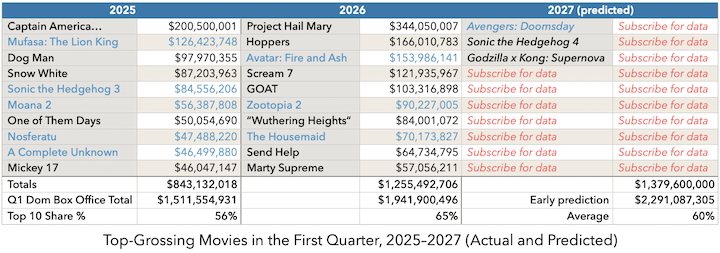
The same accounting issue limits how much weight to put on an outside quarterly preview. The Numbers projected $2.29 billion for the first quarter of 2027, which supports the case for a strong start. But its first-quarter 2026 comparison credited $344 million to Project Hail Mary, against $177 million in January–March receipts at Box Office Mojo. The preview is useful for direction, not as a dollar-for-dollar input to the Mojo total. (The Numbers quarterly preview; Box Office Mojo monthly grosses)
Uncertainties
The largest unknown is attendance outside the opening weekends of the biggest films. A crowded summer can support strong traffic, but it can also divide audiences and premium screens. A wider slate helps if mid-tier releases keep selling tickets after opening weekend. Higher prices cushion softer turnout; they do not make up for several large films underperforming at once. The 50.6% chance of exceeding $10 billion reflects how closely balanced those outcomes are.
The schedule also remains provisional. A late-December title that moves into 2028 takes its entire in-year contribution with it. In the other direction, longer runs for the late-2026 films or several unexpected breakouts would lift the year. There were no actual 2027 receipts at the forecast cutoff, and bookings alone do not establish an exhaustive count of wide releases or how much tracked revenue nontraditional releases will bring in. The most useful updates are the actual December 2026 grosses, receipts and admissions in the first quarter of 2027, and confirmed changes to the summer and December bookings.
Forecast history
| Date | Forecast |
|---|---|
| Median 10.1, 80% range 8.85 to 11.2 |
Sources Prolepsia read
- Domestic Yearly Box Office - Box Office Mojowww.boxofficemojo.com
- IMDb | Helphelp.imdb.com
- Investor Presentationd1io3yog0oux5.cloudfront.net
- Greta Gerwig's 'Narnia: The Magician's Nephew' Movie Trailer, Release Date, Photos, Cast, News - Netflix Tudumwww.netflix.com
- November 4, 2026 - 10-Q: Quarterly report [Sections 13 or 15(d)] | AMC Entertainment Holdings, Inc. (AMC)investor.amctheatres.com
- 10-Qir.cinemark.com
- Release Calendar | Cinema Unitedcinemaunited.org
- The Numbers quarterly previewwww.the-numbers.com
- Presentation Title 1 Presentation Title 2announcements.nzx.com
- Wall Street Bets on Movie Theaters After Boffo 2026 Box Officewww.thewrap.com
The question
This question asks for the total domestic theatrical box office gross earned in the United States and Canada during calendar year 2027, from January 1, 2027, through December 31, 2027, inclusive, as reported by Box Office Mojo. The result will be expressed in billions of nominal US dollars (USD), without adjustment for inflation. The forecast covers all theatrical ticket revenue attributed to the 2027 calendar year, regardless of when individual films were originally released. This includes revenue earned during 2027 by films released in earlier years, as well as theatrical re-releases. Box Office Mojo defines its domestic market as North America, encompassing the United States, Canada, and Puerto Rico. Its domestic box office figures will be used as published, without attempting to separate Puerto Rico from the reported total. Box Office Mojo distinguishes calendar-year grosses from release-year grosses; the former is the relevant measure for this question. For historical context, Box Office Mojo reports approximately $8.657 billion in domestic box office revenue for 2025, an increase of approximately 1.0% over 2024. As of November 17, 2026, the 2026 calendar year remains incomplete. The 2027 outcome will depend on theatrical attendance, ticket prices, the commercial performance of major releases, and broader industry conditions. The primary historical and resolution source is Box Office Mojo's Domestic Yearly Box Office database (https://www.boxofficemojo.com/year/?area=USA), with the specific 2027 calendar-year page at https://www.boxofficemojo.com/year/2027/?grossesOption=calendarGrosses. Box Office Mojo's methodology is described at https://www.boxofficemojo.com/article/ed3547792388/.
How it resolves
The question will resolve to the total domestic calendar-year box office gross for 2027 reported by Box Office Mojo, expressed in billions of US dollars. The primary source will be Box Office Mojo's Domestic Box Office for 2027 page (https://www.boxofficemojo.com/year/2027/?grossesOption=calendarGrosses), specifically the aggregate gross for the calendar year, rather than the lifetime earnings of films released in 2027. The relevant figure will include theatrical ticket revenue earned from January 1 through December 31, 2027, inclusive, by all films tracked by Box Office Mojo in its domestic market. The resolution value will be calculated by dividing Box Office Mojo's reported aggregate gross in US dollars by 1,000,000,000. For example, a reported total of $9,750,000,000 would resolve to 9.75 billion USD. The outcome will be determined using the figure published on March 31, 2028, allowing approximately three months after the end of 2027 for reporting adjustments and revisions. If Box Office Mojo publishes a complete 2027 calendar-year total before that date, the figure available on March 31, 2028, will be authoritative. If the designated page is inaccessible or the aggregate figure is unavailable on that date, Box Office Mojo's Domestic Yearly Box Office summary page (https://www.boxofficemojo.com/year/?area=USA), configured to show calendar grosses, will serve as the fallback source. If Box Office Mojo has changed its website structure, the equivalent official Box Office Mojo calendar-year domestic gross figure will be used. If no complete 2027 calendar-year total can be obtained from Box Office Mojo or its official archived publications by June 30, 2028, the question will be annulled rather than resolved using another provider's potentially different methodology. Historical or subsequently revised figures published after the resolution date will not change the outcome.
Fine print
The measure is nominal theatrical box office revenue, not inflation-adjusted revenue, admissions, distributor rentals, studio profits, or worldwide box office revenue. It excludes revenue from streaming, premium video-on-demand, physical media, television licensing, and other non-theatrical distribution. Revenue is attributed to the calendar year in which tickets were sold or box office receipts were recorded, according to Box Office Mojo's reporting conventions, rather than the original release year of the film. Films released in late 2026 that continue playing in 2027 contribute only their 2027 theatrical grosses. Similarly, films released in late 2027 contribute only their 2027 grosses, excluding revenue earned during 2028. Re-releases and special theatrical engagements are included to the extent they are reflected in Box Office Mojo's calendar-year data. The domestic market follows Box Office Mojo's own geographic definition, which includes Puerto Rico alongside the United States and Canada. No separate geographic adjustment will be made. Amounts will be reported in billions of US dollars, with the underlying dollar figure retained at full available precision for resolution. The forecast range of 4 to 14 billion USD is intended to encompass a broad set of plausible outcomes, not to impose hard limits on the actual result. A reported total outside this interval will remain valid. Box Office Mojo's reported total is authoritative even if another box office tracking organization publishes a different estimate.
More public forecasts
What will Star Wars: Starfighter gross worldwide by 31 August 2027, in millions of US dollars, according to Box Office Mojo?
480median
Prolepsia forecast
Will Avengers: Doomsday gross more than US$1.5 billion worldwide by 31 March 2027, according to Box Office Mojo?
96%chance of yes
Prolepsia forecast
What total losses will the FBI's 2026 Internet Crime Report state were reported to IC3 for calendar year 2026?
25.4median
Prolepsia forecast
Will the US, Mexico and Canada all agree to extend the USMCA trade deal by 31 December 2027?
36%chance of yes
Prolepsia forecast
Will the Bank of Canada's policy rate be below 2.25% on 31 December 2027?
15%chance of yes
Prolepsia forecast
How many CVE records will NIST's National Vulnerability Database list as published in calendar year 2027?
Prolepsia forecast