Prolepsia forecastYes / no
Will the California FAIR Plan hold more than 700,000 policies on 31 December 2027?
As of 17 November 2026, Prolepsia puts the chance of yes at 40%.
40%chance of yes
How Prolepsia reasons
The report Prolepsia wrote with this forecast.
How forecasts are made · Track record
TL;DR
The saved forecast is 40.3% Probability of Yes and 59.7% Probability of No, conditional on the question not being annulled. A count of 700,000 or fewer on December 31, 2027 is more likely because the FAIR Plan’s rapid expansion has slowed toward a plateau, while management anticipates modest contraction.
Key evidence
- The threshold is close, but the measurement date matters. The latest headline count was 698,307 policies at September 30, 2026, leaving only 1,694 additional policies needed for YES. The target comes fifteen months later, allowing an earlier threshold crossing to reverse before resolution (FAIR Plan statistics).
- Recent growth is much weaker than the annual history suggests. The reported June 2026 headline count was 696,562, implying only 1,745 net additions through September. The June observation has weaker provenance because it is preserved in contemporaneous reporting rather than the original headline release (contemporaneous reporting).
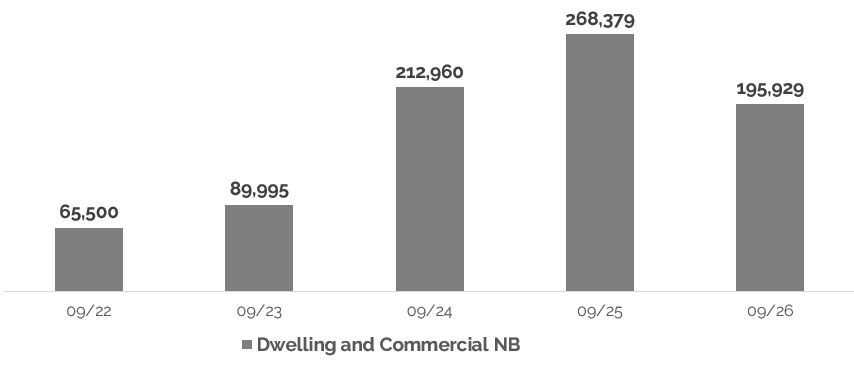
- New business is falling, and management expects contraction. Fiscal-2026 new business totaled 195,929 policies, down 27% from fiscal 2025 (FAIR Plan statistics). Management’s projection anticipated 703,047 policies for September 2026 and 699,000 for September 2027. That is a planning projection, not a forecast for the question’s December measurement date (strategic plan).
- Official totals disagree. The September county report gives 686,376 policies, 11,931 below the headline, without reconciling the difference (county report).
Uncertainties
The strongest risk to the NO-leaning forecast is that private-market recovery remains too slow to reduce FAIR Plan enrollment. State Farm and Allstate reopening filings were not completed reopenings when announced, and proposed capacity is not the same as actual FAIR Plan transfers (insurance department announcement).
Higher FAIR Plan premiums and lower broker commissions encourage remarketing, but their effect depends on available alternatives. Renewed wildfire-related market stress or slower regulatory implementation could sustain growth. The unresolved reporting discrepancy also matters because the threshold is so close. Resolution requires the official all-lines active-policy count for December 31, 2027—not residential enrollment alone, insured exposure, or the highest count reached earlier.
Read the full report
TL;DR
The saved forecast is 40.3% Probability of Yes and 59.7% Probability of No, conditional on a non-annulled outcome. The forecast favors 700,000 or fewer active policies on December 31, 2027 because growth has slowed sharply and management projects modest contraction. An earlier crossing of 700,000 does not settle this question; the decisive measure is the active all-lines policy count on the target date.
Context
California’s FAIR Plan is the property insurer of last resort. Its expansion reflects difficulty obtaining coverage in the traditional market, especially in wildfire-exposed areas. The latest official headline statistics report 698,307 policies at September 30, 2026, close to the question’s threshold (FAIR Plan statistics). California’s Sustainable Insurance Strategy seeks to expand private-market coverage and reduce reliance on the Plan (strategy overview).
The question measures a stock, not a flow: all qualifying policies active on December 31, 2027. YES requires at least 700,001. Residential, dwelling, commercial and business-owner’s policies count; private supplemental coverage does not. The December quarterly observation governs, rather than the September fiscal-year-end count. If the specified official count cannot be established by the resolution deadline, the question is annulled rather than resolved from an estimate.
Evidence
The historical backbone points toward expansion. Every annual transition in the supplied September headline series was positive. But the record is short and spans a changing insurance market. Those increases are not independent evidence that growth will continue at the same rate.
The full supplied headline stock history, including intervening quarterly observations, is:
| Observation date | Total policies in force | Supporting record |
|---|---|---|
| September 2022 | 271,327 | Official headline chart |
| September 2023 | 330,275 | Official headline chart |
| September 2024 | 464,900 | Official headline chart |
| September 2025 | 645,987 | Official headline chart |
| December 2025 | 668,609 | FAIR Plan oversight presentation |
| March 2026 | 684,388 | Senate hearing document described in the research |
| June 2026 | 696,562 | Contemporaneous reporting quoting FAIR |
| September 2026 | 698,307 | Official headline chart |
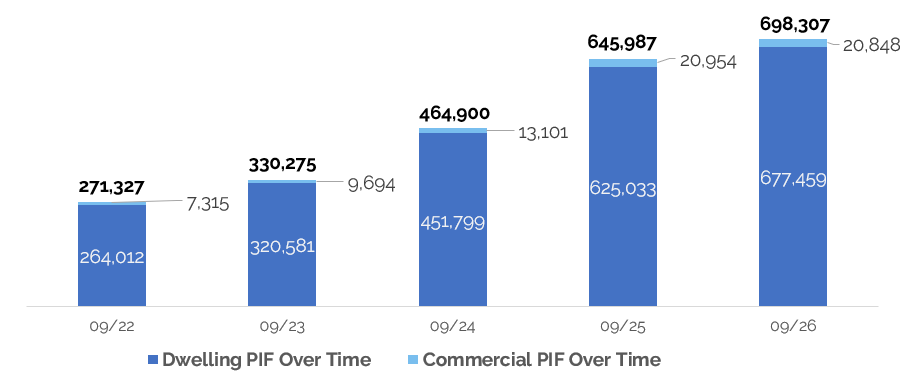
These observations have different publication vintages. The June figure is less secure than the current September headline because the original June release was not established in the supplied research. Even with that qualification, the direction is clear: expansion slowed sharply. The June-to-September increase was only 1,745 policies, against a full-year increase of 52,320. Only 1,694 additional policies are needed for YES, so continued slow growth remains a serious counterargument (headline statistics; June reporting).
Gross business flows explain why a small remaining gap does not make YES the leading outcome. New-business policies fell from 268,379 in fiscal 2025 to 195,929 in fiscal 2026, a 27% decline (new-business chart). Subtracting the 52,320 increase in the headline stock leaves an accounting residual of 143,609 departures or other stock adjustments. That residual is not a verified cancellation count, and it does not establish how many customers moved to private insurers. It does show that net growth is the small difference between much larger flows. A modest further fall in admissions, or rise in departures, can turn growth into contraction.
Management’s own planning points in that direction. Projections prepared as of August 31, 2026 anticipated 703,047 policies for September 2026 and 699,000 for September 2027—a decline of 4,047. The subsequent September 2026 headline came in 4,740 below the projected starting point (strategic plan). This is evidence against simply extending the earlier expansion. It is not an official December 2027 forecast, and the plan supplies no prediction interval.
Renewal economics add downward pressure. Effective October 15, 2026, FAIR reduced broker commissions from 10% to 7% on new business and from 8% to 3% on renewals. The same bulletin describes an average dwelling-rate increase of 29.1% (broker bulletin). Higher customer costs and lower renewal compensation create reasons to search for private alternatives. The inference is directional, not proportional: a premium increase does not imply a matching enrollment decline.
There are signs that distribution channels are preparing to act. Underwrite markets a workflow for importing FAIR books, screening properties and remarketing eligible accounts after the commission cuts (remarketing offering). That is a weak signal of preparation, not evidence of completed transfers or sufficient underwriting capacity.
Private-insurer developments are mixed. Farmers removed its new-business cap and targeted at least 300,000 consumers in distressed areas, but outreach is not completed FAIR Plan takeout activity (insurance department announcement). State Farm and Allstate filed plans to reopen, but the department explicitly said neither was open under those filings when it announced them. State Farm’s proposal also involved wildfire-preparedness eligibility standards (reopening announcement). These developments support prospective relief without establishing rapid depopulation.
Timing further limits the case for immediate exits. AB 69’s expanded policyholder-information sharing starts January 1, 2028, after the measurement date. Transfer reporting starts May 1, 2027. Existing clearinghouses can operate earlier, but the later enhancement should not be treated as a driver of departures before it takes effect (chaptered bill text).
The largest measurement problem is a conflict within official reporting. The September county report, covering residential, commercial and business-owner’s lines, totals 686,376 policies—11,931 below the headline. Its reporting-period summary separately gives 665,673 residential and 20,544 commercial policies, totaling 686,217. The report warns that totals vary by data source but does not reconcile the differences (county report). The headline remains the principal reference. The lower totals create uncertainty about later corrections or reporting-basis reconciliation; they are not established replacements for it.
What's non-obvious
The obvious reading is that a Plan just below the threshold needs almost no growth to produce YES. That is true, but incomplete. Proximity to the threshold is not the same as momentum through the target date. The annual growth figure conceals a much slower recent quarter, falling gross admissions and a management projection for contraction. Fifteen months separate the latest observation from resolution. That leaves room for the Plan to cross the threshold and later fall below it.
The opposite narrative also overreaches. Announced private capacity, marketing campaigns and broker incentives do not prove that FAIR customers can obtain acceptable replacement coverage. A broker needs an insurer willing to take the risk, and a customer needs an offer worth accepting. The forecast therefore favors NO without treating large-scale depopulation as established. Modest continued growth remains enough to defeat it.
Uncertainties
The main unknown is actual post-October renewal behavior. The supplied evidence does not establish a representative retention series after the premium and commission changes. Monthly admissions, cancellations, renewals and verified private-market transfers would show whether the plateau is becoming sustained contraction.
Implementation is another gap. Final approvals, operating start dates, eligibility rules and completed FAIR-origin placements matter more than reopening announcements. Renewed wildfire losses, insurer restrictions or nonrenewals could push demand back toward the Plan. The incoming commissioner’s review of the Sustainable Insurance Strategy also introduces uncertainty, but the proposed public disaster-insurance system requires legislative and gubernatorial support; it is not an enacted replacement (November 16 reporting).
Finally, the official totals need reconciliation. A clear explanation of category coverage, effective-date treatment and corrections would narrow uncertainty near the threshold. Until then, neither the lower county total nor the higher headline should be treated as an immutable starting point. The decisive evidence remains the comparable official all-lines count for December 31, 2027.
Forecast history
| Date | Forecast |
|---|---|
| 40% chance of yes |
Sources Prolepsia read
- Key Statistics & Data - The California FAIR Planwww.cfpnet.com
- Sustainable Insurance Strategywww.insurance.ca.gov
- PowerPoint Presentationains.assembly.ca.gov
- # CALIFORNIA COURIERnewsclips.cao.sbcounty.gov
- broker bulletinwww.iiabcal.org
- California FAIR Plan commission cuts — move your book to carriers who pay | Underwritewww.underwrite.com
- AB 69: FAIR Plan policy notices and renewals. | Digital Democracycalmatters.digitaldemocracy.org
- Incoming California Commissioner Kim to Review Lara’s Insurance Reformsamp.insurancejournal.com
- State Farm and the California Insurance Marketplacenewsroom.statefarm.com
- In Major Move to Expand Growth, Farmers Insurance® to Remove Cap on Writing New Homeowners Insurance Policies in California and Submits New Rating Plan - Nov 21, 2025newsroom.farmers.com
The question
This question asks whether the California FAIR Plan Association, California's insurer of last resort for property insurance, will have more than 700,000 active insurance policies in force on December 31, 2027. The count includes all residential, dwelling, commercial, and business owner's policies administered by the California FAIR Plan, rather than residential policies alone. As of November 17, 2026, the latest available official statistics show that the FAIR Plan had 698,307 policies in force as of September 2026, representing an 8% increase from September 2025 and a 157% increase from September 2022. The FAIR Plan's total insured exposure reached approximately $773 billion in September 2026. This rapid expansion reflects difficulties obtaining property insurance through California's traditional insurance market, particularly in areas exposed to wildfire risk. However, recent growth has slowed, and California's Sustainable Insurance Strategy aims to encourage traditional insurers to expand coverage in underserved areas and reduce reliance on the FAIR Plan. The question therefore concerns whether the FAIR Plan's total policy count will exceed 700,000 at the end of calendar year 2027, regardless of whether that threshold was reached at any earlier point. Sources: California FAIR Plan, Key Statistics & Data (https://www.cfpnet.com/key-statistics-data/); California Department of Insurance, Sustainable Insurance Strategy (https://www.insurance.ca.gov/01-consumers/180-climate-change/Sustainable-Insurance-Strategy.cfm).
How it resolves
The question resolves YES if the California FAIR Plan Association has at least 700,001 total policies in force as of December 31, 2027. It resolves NO if the total is 700,000 or fewer. The primary resolution source will be the California FAIR Plan Association's official policy statistics, available through its Key Statistics & Data webpage (https://www.cfpnet.com/key-statistics-data/) or its published statistical reports. The relevant metric is total policies in force (PIF), including residential, dwelling, commercial, and business owner's policies, rather than the number of policyholders, properties insured, applications received, new policies written during the year, or total insured exposure. The count must represent policies active on December 31, 2027, including policies effective on that date and excluding expired, cancelled, or otherwise inactive policies. Because the FAIR Plan publishes statistics quarterly and its fiscal year ends on September 30, the December 31, 2027 quarterly reporting date will be used rather than the September 2027 fiscal-year-end figure. The question will resolve once the official December 31, 2027 count is published, even if publication occurs in 2028. If the FAIR Plan does not publish the relevant quarterly count, official California Department of Insurance statistics or regulatory filings explicitly reporting the same metric for December 31, 2027 may be used instead. If multiple official figures are published, the latest corrected figure available within six months of December 31, 2027 will take precedence, with FAIR Plan records preferred over secondary sources. If no reliable official figure for that date is available by June 30, 2028, and the count cannot be established from official records, the question will be annulled rather than resolved using an estimate or a different reporting date.
Fine print
The threshold is strictly greater than 700,000; exactly 700,000 policies resolves NO. The question concerns the number of active policies at the specified date, not the maximum number reached at any point during 2027. A policy that was active earlier in 2027 but terminated before December 31 does not count. Different policies issued to the same person or covering the same property count separately if the FAIR Plan records them as separate active policies. All California FAIR Plan property insurance lines included in its official total policies-in-force reporting are counted. Insurance policies issued by private insurers outside the FAIR Plan, including supplemental Difference in Conditions policies, are excluded. If the FAIR Plan changes its reporting categories, the most directly comparable aggregate count of active FAIR Plan policies should be used, avoiding double-counting. If the FAIR Plan undergoes a reorganization, merger, or administrative restructuring before December 31, 2027, policies remaining in force under a legally designated successor that directly assumes the FAIR Plan's insurance obligations will be included. Policies transferred to unrelated private insurers will not count. If the FAIR Plan ceases operating before the target date without a successor administering its policies, the question resolves NO, provided official records establish that no qualifying FAIR Plan policies remain in force.
More public forecasts
Will the US Labor Department finalize rules that make it easier for 401(k) plans to hold private markets funds before 31 December 2027?
97%chance of yes
Prolepsia forecast
Will Florida Citizens Property Insurance hold fewer than 700,000 policies on 31 December 2027?
99%chance of yes
Prolepsia forecast
Will a US appeals court rule that training AI on copyrighted web content is fair use before 31 December 2027?
26%chance of yes
Prolepsia forecast
Will off-plan properties make up at least 75% of Dubai's residential sale records in December 2026?
5%chance of yes
Prolepsia forecast
Will the EU approve a new joint borrowing plan for defence before 31 December 2027?
83%chance of yes
Prolepsia forecast
Will Microsoft raise the price of any Microsoft 365 business plan in 2027?
18%chance of yes
Prolepsia forecast