Prolepsia forecastYes / no
Will the Republican Party control the House after the 2026 Midterm elections?
As of 6 October 2026, Prolepsia puts the chance of yes at 16%.
16%chance of yes
How Prolepsia reasons
The report Prolepsia wrote with this forecast.
TL;DR
The forecast as of October 6, 2026, is 16% Yes and 84% No. Democrats are clear favorites because their national polling advantage is larger than the Republican map advantage, while district ratings also give them the easier route to a majority.
Key evidence
- National polls favor Democrats by a substantial margin. The latest check puts RealClearPolling at D+7.8 raw percentage points across ten polls fielded September 16–October 5. That is the current reading used here, rather than the earlier D+8.2 snapshot (RealClearPolling).
- The map protects Republicans, but not enough to erase that lead. An examination of all 435 districts using 2024 presidential returns on 2026 boundaries confirms a presidential-equivalent majority threshold near D+3.0. Allowing for candidates and congressional voting differences, the analysis uses an effective threshold of D+3.5. The geographic benchmark is not a guaranteed House-vote cutoff (The Downballot district data).
- The operative map matters. The Supreme Court’s September 25 order confirms that Missouri uses its 2022 map, not the attempted replacement. Counting the proposed extra Republican seat would overstate Republican protection (Supreme Court order).
- Race ratings support Democratic favoritism. Cook’s September 25 board favors Democrats in 208 seats and Republicans in 205, with 22 tossups. If favored seats hold, Democrats need ten tossups and Republicans need thirteen. Cook also expects the out-party to win most tossups (Cook Political Report).
Uncertainties
The strongest Republican counterweight is direct battleground polling: Cook found Democrats ahead only 49%–47% across 37 competitive districts. Those districts were Republican-leaning in the preceding presidential election, so this is not evidence of a national two-point race. It does show that the contests deciding control remain close (Cook battleground survey).
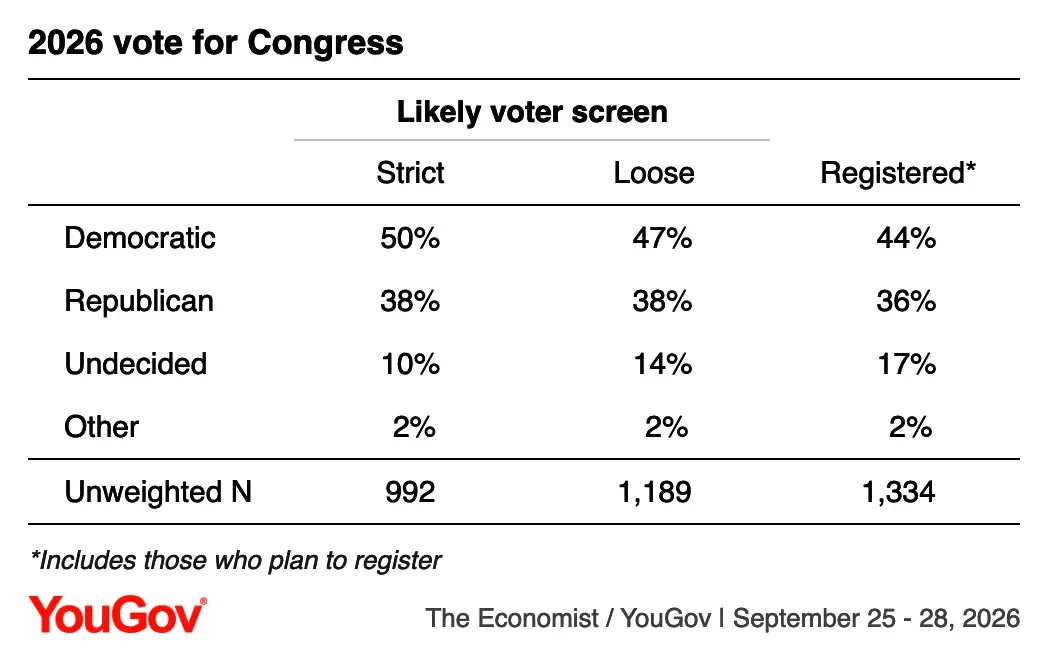
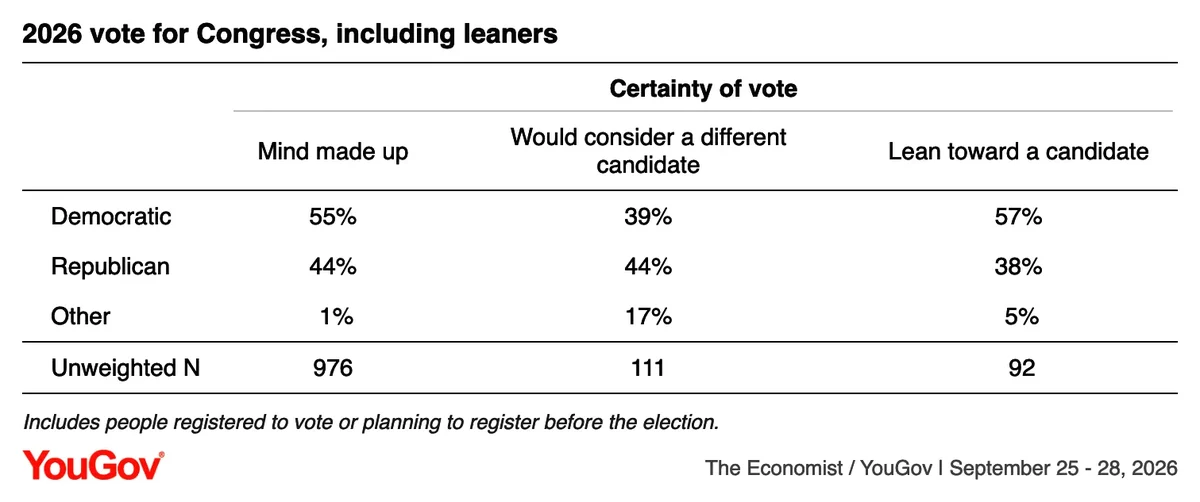
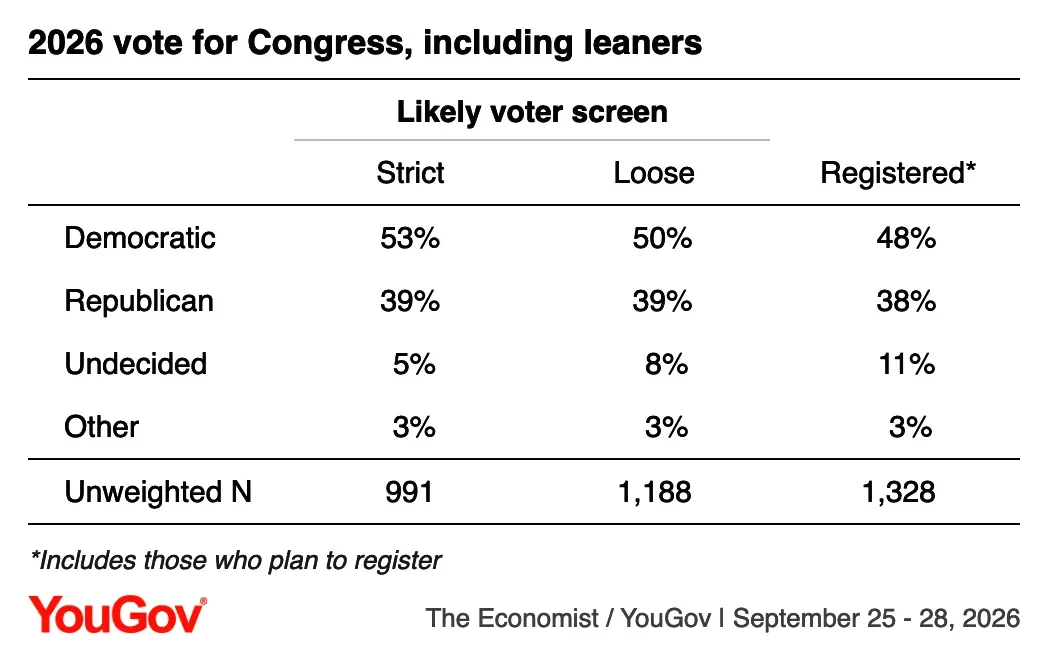
Turnout screens, undecided-voter treatment, and shared survey errors remain consequential. YouGov’s October 5 methodological note illustrates why likely-voter estimates and results including or excluding leaners must be compared carefully (YouGov). A Republican win most plausibly comes from a smaller election-day Democratic lead plus favorable local performance—not geography alone overcoming the current polling advantage.
Read the full report
TL;DR
The forecast as of October 6, 2026, is 16% Yes and 84% No. Democrats are clear favorites because their national polling lead exceeds the Republican map advantage and their district-level path to a majority is easier. The Republican retention path runs through shared polling error, turnout recovery, and candidate strength in the seats that decide control.
Context
This question concerns control of the House elected to the 120th Congress, not control of the outgoing chamber. The ordinary majority target is 218 of 435 voting seats. Under the supplied resolution rules, seats follow the party under which members were elected, with qualifying independent caucus affiliations included. Runoffs determine the attribution of affected seats. If neither party wins a majority, the affiliation of the first elected Speaker determines control.
The election is scheduled for November 3, 2026, about four weeks after the forecast date (Federal Election Commission). The key question is not simply who wins more votes nationwide. It is whether the Democratic advantage is large enough, and spread efficiently enough, to overcome Republican district geography and local candidate advantages.
Evidence
History gives the incumbent party a difficult starting point. In the eight midterms from 1994 through 2022, the president’s party lost House seats six times. The complete sequence supplied for that period is below, using the source’s initial-election party-division convention (American Presidency Project).
| Midterm | President’s party House-seat change |
|---|---|
| 1994 | −54 |
| 1998 | +4 |
| 2002 | +8 |
| 2006 | −30 |
| 2010 | −63 |
| 2014 | −13 |
| 2018 | −41 |
| 2022 | −9 |
The average loss across those elections was 24.75 seats. That is context, not a seat prediction. Starting majorities, district maps, and party coalitions differ. Republicans won 220 seats in the preceding election, leaving little room for losses against the ordinary majority target. That is an election-result baseline, not a count of occupied seats on the forecast date (American Presidency Project).
The strongest current evidence is national polling. The latest October 6 check puts RealClearPolling at D+7.8 raw percentage points across ten polls fielded September 16–October 5. This supersedes the earlier D+8.2 reading in the research. Either way, the national picture is substantially Democratic-favorable (RealClearPolling).
Other polling treatments point in the same direction. Silver Bulletin reported D+8.9 in its default average and D+9.6 after its likely-voter adjustment. These are not independent confirmations: the averages share underlying surveys. Their agreement supports the direction of the national environment, but does not eliminate shared error (Silver Bulletin).
Individual surveys disagree sharply. Emerson found Democrats ahead 53%–42% among 1,000 likely voters in September 21–22 fieldwork. Harvard-Harris found a much closer 51%–49% among its likely-voter subgroup in September 26–28 fieldwork (Emerson; Harvard-Harris). The closer result is real counter-evidence. It shows why the national average should not be treated as an election-day certainty.
Survey definitions matter too. YouGov’s October 5 note explains problems with its earlier likely-voter treatment and distinguishes results including leaners from those excluding them. Alternative screens applied to the same sample are not new polls. Nor can differently defined estimates be substituted as though they measure the same thing (YouGov methodological note). The forecast therefore retains a substantial allowance for turnout and measurement uncertainty rather than treating the strongest Democratic headline as settled fact.
The second pillar is district geography. The examination of all 435 districts in The Downballot’s September 3 file vintage, using 2024 presidential returns on 2026 boundaries, confirms a presidential-equivalent majority threshold near D+3.0. Wisconsin’s 1st District sits at the tipping point. Its presidential margin is roughly 4.5 points Republican, against a national presidential baseline of roughly 1.5 points Republican (The Downballot district data).
That arithmetic explains the Republican structural advantage. Under a uniform shift, Democrats need a positive national margin merely to reach the district median. It also shows that they do not need an eight-point national lead just to become competitive for control.
Presidential returns are a benchmark, not an actual House-vote threshold. Incumbency, candidate quality, ticket-splitting, and district turnout change the conversion. The analysis uses an effective threshold of D+3.5, with 1.25 points of uncertainty, to allow for those differences. This is an analytical assumption, not a measured cutoff.
The operative maps must be separated from proposed maps. The Supreme Court’s September 25 order confirms Missouri’s use of its 2022 map rather than the attempted replacement. Earlier assessments that assumed an additional Republican seat there overstate the protection available in this election (Supreme Court order).
Cook’s R+3 median PVI is a different measure. PVI describes a two-party vote-share difference relative to the nation, not a Democratic-minus-Republican margin difference. It cannot simply be read as the same three-point threshold. Its use of multiple presidential elections and the uncertainty about its post-Missouri vintage further limit a literal translation into House control (Cook PVI).
Current race ratings reinforce Democratic favoritism. Cook’s September 25 assessment favors Democrats in 208 seats, Republicans in 205, and leaves 22 tossups. If favored seats hold, Democrats need ten tossups while Republicans need thirteen. Cook also expects the out-party to win most tossups (Cook Political Report). Sabato’s September 29 board is more Democratic-favorable: 213 Democratic-favored seats, 202 Republican-favored seats, and 20 tossups (Sabato’s Crystal Ball). These are judgments about competitiveness, not calibrated win probabilities.
Direct battleground polling supplies the strongest geographic counterweight. Cook surveyed 1,052 likely voters across 37 competitive districts on September 8–11 and found Democrats ahead 49%–47%. Those districts had voted for Trump by an average of about five points in 2024. The result thus shows movement toward Democrats in Republican-leaning territory, while confirming that the deciding contests remain close. It is one pooled survey, not 37 individually precise district polls (Cook battleground survey).
Behavioral evidence supports the Democratic direction. State-legislative special elections through September 25 produced 13 Republican-to-Democratic flips and none in the opposite direction. Across 62 districts contested by both parties in both the special and preceding general election, margins moved an average of 5.1 points toward Democrats. Local candidates and low-turnout selection prevent a direct national extrapolation (Ballotpedia).
Coalition and campaign evidence adds smaller signals. An NBC News/Telemundo survey found Latino registered voters preferring Democratic congressional control 59%–35%. That could weaken districts drawn around recent Republican Latino gains, but a national subgroup poll cannot establish the outcome of any particular district (NBC News/Telemundo). Republicans held a committee cash advantage—$89 million for the NRCC versus $76 million for the DCCC at August 31—but advertising research found relatively balanced spending in many major House contests. Cash reserves do not automatically become local advertising dominance (Axios; Wesleyan Media Project).
What's non-obvious
Republicans do not need to win the national popular vote to retain the House. Their geographic advantage gives them a route through a Democratic lead reduced to the low-to-middle single digits. But the reverse misconception also matters: Republican redistricting does not make the House safe against a large Democratic national advantage. The district data puts the geographic hurdle well below the current polling lead.
The close battleground survey and strong national polls are not contradictory. They describe different electorates. Competitive districts begin more Republican than the country, so a narrow Democratic lead there can coexist with a much larger national advantage. Ratings also miss something when read as neutral coin flips: Cook explicitly expects the out-party to win most tossups. The useful conclusion is not that geography disappears. It is that current Democratic strength appears sufficient to cross it.
Uncertainties
The principal risk is correlated polling error. More respondents and more pollsters reduce ordinary sampling noise, but they do not remove errors shared across surveys. Turnout screens, nonresponse, and undecided allocation can all move the election-day electorate toward Republicans. Late campaign movement can reinforce the same shift.
The analysis discounts the latest two-party polling indication by a judgmental 1.5 points rather than taking it literally. It also allows broad shared polling and remaining-campaign uncertainty, including unusually large misses. These allowances preserve the Republican retention path without changing the central conclusion.
The vote-to-seat relationship remains less certain than the presidential district ranking. Better independent polling in redrawn and tipping-point districts would help establish whether Republican incumbents and candidates outperform the national environment. Stronger historical evidence measured at a comparable October cutoff would also improve the assessment of shared polling error. The available historical comparisons are too limited and heterogeneous to establish a precise partisan correction.
Finally, independents and runoffs can complicate the resolution of a very close chamber. The supplied rules settle how those seats are counted, but they do not establish every candidate’s eventual caucus decision. If neither party wins a majority, the Speaker provision becomes decisive. These are secondary uncertainties. The main contest remains whether the Democratic national advantage survives and converts into enough district victories.
Forecast history
| Date | Forecast |
|---|---|
| 16% chance of yes |
Sources Prolepsia read
- Domain Expert Search
- Domain Expert Research Task
- ygo-assets-websites-editorial-emea.yougov.netygo-assets-websites-editorial-emea.yougov.net
- d3nkl3psvxxpe9.cloudfront.netd3nkl3psvxxpe9.cloudfront.net
- 2026 Generic Congressional Vote | RealClearPollingwww.realclearpolling.com
- datawrapper.dwcdn.netdatawrapper.dwcdn.net
- d3nkl3psvxxpe9.cloudfront.netd3nkl3psvxxpe9.cloudfront.net
- yougov.comyougov.com
- Likely voters and the 'blue wave'yougov.com
- d3nkl3psvxxpe9.cloudfront.netd3nkl3psvxxpe9.cloudfront.net
- yougov.comyougov.com
- yougovamerica.substack.comyougovamerica.substack.com
- docs.google.comdocs.google.com
- ygo-assets-websites-editorial-emea.yougov.netygo-assets-websites-editorial-emea.yougov.net
- Claude Code
- Fifteen House Ratings Shift Toward Democratsthecookpoliticalreport.substack.com
- datawrapper.dwcdn.netdatawrapper.dwcdn.net
- 26A388 People Not Politicians v. Onder (09/25/2026)www.supremecourt.gov
- Taking Stock of the 2026 House Map: An Updatesabatoscrystalball.substack.com
- rasmussenreports.comwww.rasmussenreports.com
- cookpolitical.comwww.cookpolitical.com
- cookpolitical.comwww.cookpolitical.com
- NY-17 2026 Poll: Conley 48%, Lawler 46% - Emerson Pollingemersoncollegepolling.com
- dccc.orgdccc.org
- punchbowl.newspunchbowl.news
- apnews.comapnews.com
- courts.mo.govwww.courts.mo.gov
- supremecourt.govwww.supremecourt.gov
- apnews.comapnews.com
- census.govwww.census.gov
- supremecourt.govwww.supremecourt.gov
- ec2-3-16-228-157.us-east-2.compute.amazonaws.comec2-3-16-228-157.us-east-2.compute.amazonaws.com
- the-downballot.comwww.the-downballot.com
- docs.google.comdocs.google.com
- cookpolitical.comwww.cookpolitical.com
- aol.comwww.aol.com
- aol.comwww.aol.com
- uh.eduwww.uh.edu
- dccc.orgdccc.org
- bipartisanpolicy.orgbipartisanpolicy.org
- en.wikipedia.orgen.wikipedia.org
- govinfo.govwww.govinfo.gov
- en.wikipedia.orgen.wikipedia.org
- brookings.eduwww.brookings.edu
- nrcc.orgwww.nrcc.org
- dccc.orgdccc.org
- Exclusive: House GOP hits record cash advantage over Democratswww.axios.com
- congressionalleadershipfund.orgcongressionalleadershipfund.org
- axios.comwww.axios.com
- prospect.orgprospect.org
- sacurrent.comwww.sacurrent.com
- September 2026 National Poll: Democrats with 11-Point Congressional Midterm Ballot Advantage - Emerson Pollingemersoncollegepolling.com
- pro-assets.morningconsult.compro-assets.morningconsult.com
- 2026 United States House of Representatives election ratings - Wikipediaen.wikipedia.org
- en.wikipedia.orgen.wikipedia.org
- nbcnews.comwww.nbcnews.com
- National Release – September 29, 2026poll.qu.edu
- The Cook Partisan Voting Index (Cook PVI℠) | Cook Political Reportwww.cookpolitical.com
- Seats in Congress Gained/Lost by the President's Party in Mid-Term Elections | The American Presidency Projectwww.presidency.ucsb.edu
- Los votantes latinos se alejan de Trump y de los republicanos, según encuesta de NBC News/Telemundowww.telemundo.com
- Dems Lag in Senate Ad Spending; U.S. Government Spends $3.5M on Ads Touting Trump Administration - Wesleyan Media Projectmediaproject.wesleyan.edu
- Just 2% of pro-Paxton GOP spending blitz is for Spanish adswww.texastribune.org
- Heading into the midterms, Democrats have flipped 13 Republican state legislative seats in special elections since President Donald Trump (R) took office - Ballotpedia Newsnews.ballotpedia.org
- 2026 Battleground District Project | Cook Political Reportwww.cookpolitical.com
- ‘Guess we’ll find out’: Hill won’t say if he’ll caucus with Democrats in challenge against Rep. Nick Begichwww.alaskasnewssource.com
- Generic Congressional Ballot: Latest Polls | Silver Bulletinwww.natesilver.net
- Untitled.Qharvardharrispoll.com
- trackthevote.netwww.trackthevote.net
- ipsos.comwww.ipsos.com
- Generic Congressional Ballot - Rasmussen Reports®www.rasmussenreports.com
- cbsnews.comwww.cbsnews.com
- President Trump Job Approval | RealClearPollingwww.realclearpolling.com
- natesilver.netwww.natesilver.net
- apnorc.orgapnorc.org
- pro-assets.morningconsult.compro-assets.morningconsult.com
- cookpolitical.comwww.cookpolitical.com
- New Battleground District Poll Shows Democrats Up, Voters Eager for Sweeping Change | Cook Political Reportwww.cookpolitical.com
- pollingsource.compollingsource.com
- realclearpolitics.comwww.realclearpolitics.com
- fivethirtyeight.comfivethirtyeight.com
- fivethirtyeight.comfivethirtyeight.com
- aapor.orgaapor.org
- kff.orgwww.kff.org
- GOP Redistricting Edge Blunted by Missouri Reverting to Old Map, Overall Environmentsabatoscrystalball.substack.com
- en.wikipedia.orgen.wikipedia.org
- House Republicans on track to lose majoritywww.axios.com
- Will Republicans Wake Up As September Ends? 11 More House Ratings Changes Towards Democratssabatoscrystalball.substack.com
- sos.state.tx.uswww.sos.state.tx.us
- reed.policymap.comreed.policymap.com
- apnews.comapnews.com
- sos.ca.govwww.sos.ca.gov
- archive.vnarchive.vn
- ncleg.govwww.ncleg.gov
- ohiosos.govwww.ohiosos.gov
- ohiosos.govwww.ohiosos.gov
- gis.utah.govgis.utah.gov
- flsenate.govwww.flsenate.gov
- flsenate.govwww.flsenate.gov
- capitol.tn.govcapitol.tn.gov
- wapp.capitol.tn.govwapp.capitol.tn.gov
- apnews.comapnews.com
- redist.legis.la.govredist.legis.la.gov
- legis.la.govwww.legis.la.gov
- apnews.comapnews.com
- sos.alabama.govwww.sos.alabama.gov
- sos.alabama.govwww.sos.alabama.gov
- supremecourt.govwww.supremecourt.gov
- Statement from Missouri Secretary of State Denny Hoskinswww.sos.mo.gov
- sos.mo.govwww.sos.mo.gov
- apnews.comapnews.com
- 270towin.comwww.270towin.com
- 270towin.comwww.270towin.com
- House – Inside Electionsinsideelections.com
- insideelections.cominsideelections.com
- 270towin.comwww.270towin.com
- 2026 CPR House Race ratings | Cook Political Reportwww.cookpolitical.com
- almanacofamericanpolitics.substack.comalmanacofamericanpolitics.substack.com
- axios.comwww.axios.com
- politicalwire.compoliticalwire.com
- apnews.comapnews.com
- cookpolitical.comwww.cookpolitical.com
- FEC | Election and voting informationwww.fec.gov
- CPR In Brief - September 29, 2026thecookpoliticalreport.substack.com
- quantus.substack.comquantus.substack.com
- echeloninsights.comecheloninsights.com
- pro-assets.morningconsult.compro-assets.morningconsult.com
- natesilver.netwww.natesilver.net
- issuesinsights.comissuesinsights.com
- September 2026 Verified Voter Omnibusecheloninsights.com
- cdn.cnn.comcdn.cnn.com
- 2014 Generic Congressional Vote | RealClearPollingwww.realclearpolling.com
- pewresearch.orgwww.pewresearch.org
- cookpolitical.comwww.cookpolitical.com
- realclearpolling.comwww.realclearpolling.com
- realclearpolling.comwww.realclearpolling.com
- aapor.orgaapor.org
- pewresearch.orgwww.pewresearch.org
- pewresearch.orgwww.pewresearch.org
- pewresearch.orgwww.pewresearch.org
- uspollingdata.comuspollingdata.com
- pro-assets.morningconsult.compro-assets.morningconsult.com
- raw.githubusercontent.comraw.githubusercontent.com
- 2025-2026 Redistricting Tracker: How Many Seats Could Flip? | Cook Political Reportwww.cookpolitical.com
- apnews.comapnews.com
- vacourts.govwww.vacourts.gov
- raw.githubusercontent.comraw.githubusercontent.com
- raw.githubusercontent.comraw.githubusercontent.com
- raw.githubusercontent.comraw.githubusercontent.com
- fec.govwww.fec.gov
- podcasts.apple.compodcasts.apple.com
- gelliottmorris.comwww.gelliottmorris.com
- washingtonpost.comwww.washingtonpost.com
- cookpolitical.comwww.cookpolitical.com
- September 2026 CPR Battleground Districts Methodologywww.cookpolitical.com
- cookpolitical.comwww.cookpolitical.com
- cookpolitical.comwww.cookpolitical.com
- cookpolitical.comwww.cookpolitical.com
- realclearpolling.comwww.realclearpolling.com
- aol.comwww.aol.com
- axios.comwww.axios.com
- emersoncollegepolling.comemersoncollegepolling.com
- cookpolitical.comwww.cookpolitical.com
- cookpolitical.comwww.cookpolitical.com
- d3nkl3psvxxpe9.cloudfront.netd3nkl3psvxxpe9.cloudfront.net
- the-downballot.comwww.the-downballot.com
- supremecourt.govwww.supremecourt.gov
- fiftyplusone.newsfiftyplusone.news
- cbsnews.comwww.cbsnews.com
- activote.netwww.activote.net
- d3nkl3psvxxpe9.cloudfront.netd3nkl3psvxxpe9.cloudfront.net
- raw.githubusercontent.comraw.githubusercontent.com
- raw.githubusercontent.comraw.githubusercontent.com
- github.comgithub.com
- en.wikipedia.orgen.wikipedia.org
- en.wikipedia.orgen.wikipedia.org
- en.wikipedia.orgen.wikipedia.org
- en.wikipedia.orgen.wikipedia.org
- en.wikipedia.orgen.wikipedia.org
- clerk.house.govclerk.house.gov
- split-ticket.orgsplit-ticket.org
- clerk.house.govclerk.house.gov
- github.comgithub.com
- clerk.house.govclerk.house.gov
- en.wikipedia.orgen.wikipedia.org
- ipsos.comwww.ipsos.com
- cookpolitical.comwww.cookpolitical.com
- ipsos.comwww.ipsos.com
- emersoncollegepolling.comemersoncollegepolling.com
- yougov.comyougov.com
- d3nkl3psvxxpe9.cloudfront.netd3nkl3psvxxpe9.cloudfront.net
- realclearpolitics.comwww.realclearpolitics.com
- ygo-assets-websites-editorial-emea.yougov.netygo-assets-websites-editorial-emea.yougov.net
- ipsos.comwww.ipsos.com
- apnorc.orgapnorc.org
- apnorc.orgapnorc.org
- new.insideelections.comnew.insideelections.com
- cookpolitical.comwww.cookpolitical.com
- archive.vnarchive.vn
- redistricting.lls.eduredistricting.lls.edu
- ncsl.orgwww.ncsl.org
The question
Imported from Polymarket. This yes/no question comes from a single Polymarket market.
How it resolves
This market will resolve according to the party that wins control of the United States House of Representatives in the 2026 United States midterm election. A party wins control of the United States House of Representatives if it wins a majority of the chamber’s voting seats. If no party wins a majority of voting seats, the chamber will be deemed controlled by the party with which the first elected Speaker of the House of the Congress that convenes after the 2026 midterm election is affiliated. The following rules govern the counting of seats for determining which party wins control of the chamber. All House elections in the 2026 United States midterm election that elect voting members and determine representation in the upcoming 120th Congress are included. Where a seat is decided by a runoff, the runoff result will determine attribution of that seat. Seats are attributed to the party under which the member was elected. If a member-elect changes party affiliation, or vacates their seat, between election day and the formal organization of Congress, the seat is attributed to the party under which the member was elected. House members elected as independents who formally caucus with, or, for newly elected members, who announce their intent to caucus with, a party are included in that party’s count. If the caucus decisions of members of the House elected as independents cannot be determined on the date of the election, this market may remain open until the earlier of (i) an announcement from the relevant members of their intents to caucus, or (ii) January 4th, 11:59 PM ET of the following calendar year. If no such announcement is made by January 4th, 11:59 PM ET of the following calendar year, the member will not count towards the seat count of any party. The resolution sources for this market will be official information from relevant state electoral authorities, the United States Congress, and a consensus of credible reporting.
More public forecasts
Clarity Act (H.R.3633) signed into law in 2026?
13%chance of yes
Prolepsia forecast
Will Luca Niculescu become Romania's next prime minister by December 31, 2027?
52%chance of yes
Prolepsia forecast
Will the Democratic Party control the Senate after the 2026 Midterm elections?
58%chance of yes
Prolepsia forecast